Large industrial packaging and paper-based manufacturing operations rely on consistent safety practices across multiple facilities. Kee Safety supports these organizations with a structured, nationwide program designed to simplify fall protection planning, standardize safety solutions, and create safer work environments across every location.
Industrial packaging and manufacturing facilities rely on a wide range of rooftop equipment — HVAC units, exhaust systems, dust-collection equipment, vents, solar arrays, and more. These areas require regular inspection and maintenance, which means teams are frequently exposed to fall hazards.
Kee Safety provides engineered, OSHA-compliant rooftop fall protection systems designed specifically to address the unique challenges found in large manufacturing and industrial packaging environments. From single-facility operations to nationwide networks, we help standardize safety across every rooftop.
Logic Based Approach to Danger Zones and OSHA's Safety Guidelines with trusted fall protection systems
Access points are the most frequented hazard on any rooftop. Workers are exposed to this risk twice - every time they enter and exit the roof to perform tasks. If a worker is required to access the roof 8 times per year, they are exposed to the access point hazard 16 times. OSHA requires that all ladders and hatches be secured with a self- closing gate and safety-compliant railing.
Openings are the most often overlooked hazard, so they are extremely critical to protect. OSHA considers skylights to be a hole in the rooftop which is why Kee Safety evaluates all rooftop openings as a serious risk concern. Statistically, more people fall through skylights than over the open edge of a roof.
As a worker is traversing the middle of the rooftop, they have a false sense of security. Operating far from the roof edge, carrying equipment, or focused on the job at hand, it is easy to misstep and fall through an unprotected skylight opening.
The edge of the roof is the most visible hazard, and typically the hazard most people want to protect first. Proximity to the roof edge is a significant factor in identifying the likelihood of an accident occurring. OSHA regulations cite that any building where work is performed within 15’ of an open roof edge, each worker must be protected from falling with a guardrail system or other approved safety system. Frequently, a worker’s purpose for accessing the roof is to service a piece of equipment. It is important to document if the equipment too close to an unprotected edge.
Understanding the path that workers take across the roof is necessary for a complete fall protection assessment. Obstacles on the roof force workers to unsafely climb over or step around the obstructions, often placing workers at risk by walking too close to the roof edge and slipping off.
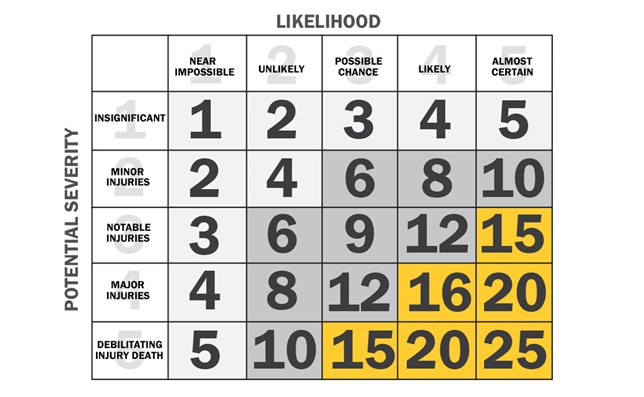
We Assess Risk Based on 2 Factors:
1. Severity of Injury: In fall protection assessment, the severity of a fall-related injury is always assumed to be life-threatening.
2. Likelihood: The greatest predictor for the likelihood of an accident occurring is to review the frequency of exposure to the hazard on the roof.
Risk = Severity X Likelihood: We prioritize our Risk Assessment based on the critical danger and how frequently workers are exposed.

Our National Accounts program helps multi-facility manufacturing organizations maintain consistent safety standards, reduce complexity, and protect their teams across every location. Contact us today to get started.