Kee Safety
Static Platform

Rooftops Are Getting Crowded: A Guide to Safe Equipment Access at Height


HVAC loads are growing, solar arrays are expanding, and mission-critical equipment is moving skyward. Your fall protection program has to catch up. This guide helps you choose the right rooftop access solution for the job.

The Rooftop Has Changed

A decade ago, the average manufacturing plant or utility facility had a relatively simple rooftop: a few exhaust fans, maybe a handful of packaged rooftop units. Today that same roof is a working floor. Condenser banks, chillers, cooling towers, solar arrays, battery storage enclosures, generator sets, and communications equipment crowd the membrane. Every one of those systems requires routine maintenance, and every maintenance visit puts workers at height.

Falls from elevation remain a leading cause of fatal workplace injury in general industry. OSHA 29 CFR 1910.28 requires employers to provide fall protection on any elevated work surface four feet or higher. The hierarchy of controls makes the preferred approach clear: passive, engineered solutions like guardrails and platforms come first, before any reliance on personal fall arrest systems.

The question for most EHS leaders is not whether they need better rooftop access. It is which solution actually fits their facility.

Adobestock 1780630124

Four Common Approaches to Rooftop Equipment Access

When a rooftop fall hazard is identified, facilities typically turn to one of four solutions. Each has a role, but they are not interchangeable, and understanding the tradeoffs is critical to building a program that actually protects workers over time.

1) Portable Ladders

Portable ladders are inexpensive and readily available, which is why they remain the default at many facilities. A technician grabs a ladder, carries it to the roof, and climbs to the equipment. 

The problem is what happens once they arrive. A ladder provides access to the equipment, not a protected work surface at the equipment. Workers still stand on unguarded elevated surfaces, lean over edges, and work in awkward postures. Every visit reintroduces the same uncontrolled fall exposure. Different technicians set ladders up differently, at different angles, in different locations. For a one-time access event on a low-risk surface, a ladder may be sufficient. For recurring maintenance, it is the weakest link in a fall protection program.

2) Temporary Scaffolding

Scaffolding provides a defined work surface with guardrails, which is a genuine step up from a ladder. For project-based work with a clear start and end date, scaffolding makes sense.

For ongoing facility maintenance, however, scaffolding introduces significant friction. It must be erected, inspected by a competent person, and disassembled after use, or left in place and periodically re-inspected. On rooftops, components are heavy and difficult to transport. Footings need to be stable on membrane surfaces without causing damage. And because scaffolding is temporary by design, it does not create a permanent safety improvement. Once it comes down, the hazard returns to its original state.

KS AE PRJ AMAZON 1105 (2)

3) Custom Welded Fabricated Platforms

Some facilities hire a local fabricator to weld a custom steel platform for a specific piece of rooftop equipment. This delivers a permanent structure, which solves the repeatability problem that ladders and scaffolding share.

The tradeoffs appear downstream. Custom-welded platforms mean long lead times, high upfront engineering costs, heavy steel construction that can strain existing roof structures, and on-roof welding that carries its own safety and logistics challenges. Most importantly, welded platforms are rigid. If the equipment they serve is replaced, relocated, or reconfigured, the platform cannot easily be modified. The original investment is stranded, and a new platform may be needed from scratch.

4) Modular Engineered Platforms

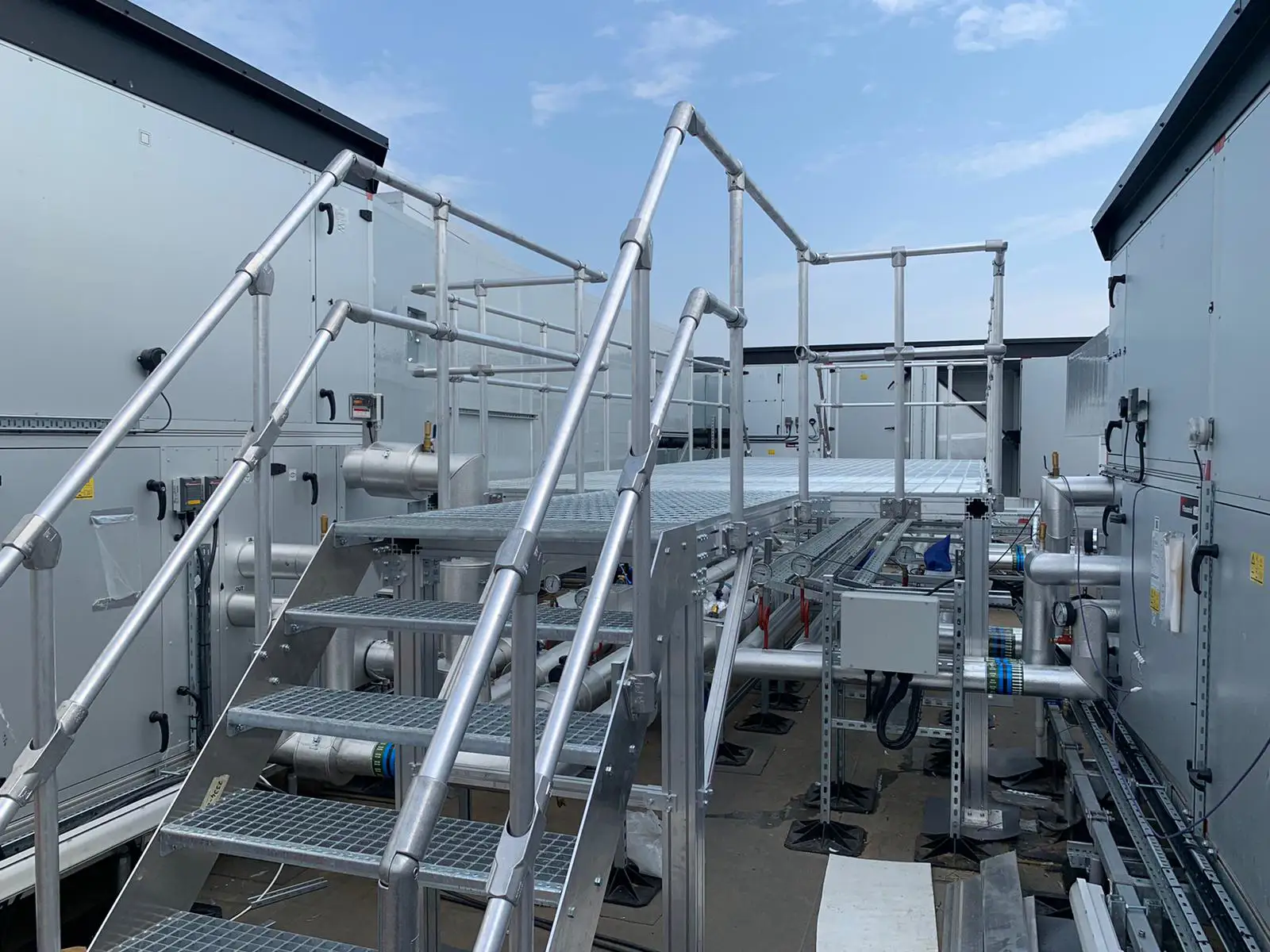
Modular engineered platforms combine the permanence and compliance of a fixed structure with the adaptability that facilities with evolving rooftop layouts actually need. They are designed for a specific application, built from standardized components, and installed as permanent infrastructure, but they can be reengineered on site if the equipment changes.

Kee Platform from Kee Safety is built on this principle. Each platform uses Kee Klamp tubular fittings and pre-cut pipe to create a custom-designed structure without welding, bending, or threading. The design process starts with the specific equipment: its dimensions, service points, the working height technicians need, and the surrounding rooftop layout.

Every Kee Platform includes integrated guardrails meeting the OSHA 42-inch top-rail height and 200-pound load requirements, with non-slip work surfaces. Platforms are designed to comply with OSHA 29 CFR 1910.23 and 1910.29, covering both the duty to provide fall protection and the design specifications for guardrail systems.

Kee Platform is available in lightweight aluminum with weighted, non-penetrating bases that distribute load across the roof membrane without fastening through it. This preserves both waterproofing integrity and manufacturer warranties, a critical consideration for data centers, hospitals, food processing plants, and other facilities where membrane damage carries outsized consequences.

How the Options Compare

Factor Portable Ladder Scaffolding Custom Welded Modular Platform
Guardrails at work position ❌ No ✅ Yes ✅ Yes ✅ Yes
Permanent Installation ❌ No ❌ No ✅ Yes ✅ Yes
Reconfigurable N/A Partially ❌ No ✅ Yes
Non-Penetrating Option N/A ❌ No Rarely ✅ Yes
On-site Welding Required ❌ No ❌ No ✅ Yes ❌ No
Lead Time Immediate Days to Weeks Weeks to Months Short
Adobestock 407944276

A Growing Problem Across Industries

The crowded rooftop is not limited to one sector. In manufacturing, HVAC intensification has packed condenser banks and RTU fleets onto roofs that were never designed for frequent foot traffic. In utilities, on-site power generation and battery energy storage are pushing more critical equipment skyward. Commercial facilities adding rooftop solar create a permanent population of workers who need safe access to panels, inverters, and disconnects for commissioning and ongoing maintenance.

Data centers represent a particularly concentrated example. A single hyperscale campus may have dozens of cooling towers, chillers, and generator sets on one rooftop, all requiring weekly service, often at night and under time pressure. Membrane integrity is paramount because any penetration can jeopardize waterproofing and manufacturer warranties. In the data center world, EHS professionals often describe the access solutions they need using terms like catwalks, maintenance platforms, work stands, scaffolding, and crossovers. Kee Platform delivers all of these functions in a single modular system: a permanent, non-penetrating platform that can be configured as a maintenance platform around a chiller, a crossover between tightly spaced equipment rows, or a catwalk connecting multiple work stands across the roof. It is specifically designed for these environments, protecting workers and preserving the roof at the same time.

Across all of these industries, the underlying pattern is the same: more rooftop equipment, more frequent maintenance, more workers from more organizations accessing the same elevated surfaces. That is the environment where permanent, passive, engineered access platforms deliver the clearest safety and compliance advantage over portable or temporary alternatives.


Kee Walk

Connecting the Full Rooftop Safety System

A platform solves the hazard at the equipment. But workers also need protection getting from the roof access point to the platform, and moving between platforms on the same roof. Kee Safety designs platform systems that integrate with Kee Walk rooftop walkways, Kee Guard perimeter guardrails, and Kee Hatch roof hatch railing and self-closing gate, to create a connected, compliant safe-access network from edge to edge. No unguarded gaps between work zones.

Adobestock 605807139

Start With a Free Hazard Assessment

The right rooftop access solution starts with understanding what you have today and where the gaps are. Kee Safety offers complimentary hazard assessment surveys conducted by experienced fall protection specialists. Our team will visit your site, evaluate every piece of rooftop equipment that requires maintenance access, document the current state of protection, and deliver a detailed report with recommended solutions and compliance priorities. 

Whether your rooftop carries a handful of RTUs or a dense field of cooling towers, chillers, and generators, the assessment gives you a clear picture of your exposure and a practical path forward. Contact Kee Safety to schedule your complimentary hazard assessment.

About the Author

Dan Huntington

Dan Huntington is a fall protection expert with over 10 years of hands-on experience helping companies protect workers at height. He specializes in OSHA compliance, risk assessments, and developing rooftop safety programs. Dan doesn’t just teach theory he’s regularly on rooftops identifying hazards and delivering practical, effective solutions. Formally trained in OSHA standards and risk assessment, Dan has presented at national safety events including the ASSP Expo and the Western States Roofing Expo. He leads Kee Safety’s rooftop safety experts across North America, helping organizations assess hazards and implement life-saving solutions. 

Author image of Dan Huntington
Kee Guard® auf einem Stehfalzdach

Safety is Kee, let us help protect your team

Please fill in your details below and we’ll be in touch shortly.